
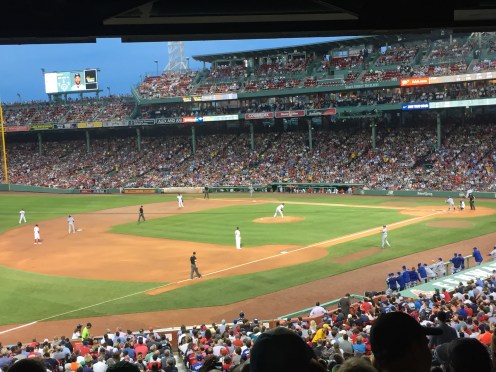
Here is my disclaimer: the things I know about sports are minimal. When the Cubs won the 2016 World Series, my wife and I watched the games. Jen was appalled that I had no idea what was going on. My knowledge of baseball is limited to the fact that there is a pitcher who throws the balls and a hitter, with a bat, who is supposed to hit the ball and run to a base. My knowledge stops there. We had gone to baseball games before, and, as we watched the first game of the World Series, she marveled at how I did not know the rules, had never spoken up, how I might have hidden this fact from her when we have been together for years and gone to at least three baseball games. There are other things at sporting events that have kept me occupied – the groups sitting behind us or beside us or in front of us who are too drunk too early off canned margaritas, there are the children who want bags of cotton candy, and hot dogs, and sodas in giant commemorative cups, there are the college students, or college dropouts, who walk around selling clam chowder and peanuts and beer and bottled water. There are fans who want to consume, at an alarming rate, all the aspects of baseball.

When I was eight or nine, my parents signed me up for a basketball team at the local Y. I was an abysmal player, but I was tall. I just didn’t have it in me. The coach shared this fact with my parents after a game where I handed the ball over to someone on the other team. She had wanted it, I had been in the way. While my parents’ dreams of me getting a basketball scholarship slowly slipped away, one quality that I already knew about myself seemed to persist: I was not aggressive or competitive. I use this memory as a prime example when I explain how not good at sports I am.
*
In high school, I attended Davidson Fine Arts Magnet School in Augusta, GA. (Magnet because it was supposed to draw students to it. It has its own force field that attracted you and kept a hold on you if you had what it took.) I had to maintain a 75 average or higher in all of my classes, or I would be sent back to my regularly zoned high school. I danced, sang, drew, took pictures, I wrote. I studied for history tests, science, math, English; I learned to love Latin. I didn’t play lacrosse or field hockey or soccer. In fact, Davidson didn’t even have sports as an option. I learned a lot about how to create. And how to continue to use creativity in my everyday life. No one told me that I could play a sport in college, or that I could, if I worked hard, play a sport as a profession. Instead, I heard that there were people who had graduated from my high school and gone on to places like Savannah College or Art and Design, Rhode Island School of Design, North Carolina School of the Arts, Berklee College of Music, or Emerson College. But I also knew that those people worked really hard, decided that art was what they wanted to do for the rest of their lives and then proceeded to figure out how they would make it work. But that’s just it – they worked. They practiced and honed their skills and tried things that didn’t work and then learned from that experience.
For the past few years, I have been teaching Latin at a regular high school in a small town in Massachusetts. A high school that has sports, but which also has art classes and drama and music. For some time, I have been struggling to articulate one of the key issues that I have with my job. The students are good, they care, they want to do well. Many, many students suffer concussions early on in sports seasons and fall behind in their school work. Students are blurry-eyed in class because they were traveling an hour each way to practice with a club team the night before, because they stayed up to watch the Pats game that started at 8 PM, because they had a late game last night. A growing population of students experience anxiety and stress and depression. I have been struggling to figure out why I have such difficulty relating to my students and the culture of the school, and one of the key factors I have found is sports. I could care less, while for some of my students, how the Pats are doing is a major part of their lives. In high school, I took for granted my unique experience in a fine arts high school, but have come to realize just what an arts education has taught me.
There are varying accounts, varying opinions on the value of sports and the arts. The arts are the thing that we hear about being cut from schools’ funding. We also hear about sports being cut from schools’ funding. Both of these headlines are devastating to the communities in which they occur. But, I have read recently that there are schools that want sports to no longer be a part of the school culture, that believe sports are the thing that distract students from learning. Rather than creating a culture of students learning leadership skills, or how to be part of a team, or fostering relationships, they are really creating a culture of competition that is not always healthy. There are some school districts that are brave enough to remove the football program from their schools.
Coaches and teammates ask children to give the game their all, give it everything they’ve got at that moment. If they can do that, then they will win the game. How many times have I thought to myself, to my students, if you worry about the material, about learning Latin (because this is what I teach), then you will get good grades. I have tried talking to my students the way I imagine a coach might talk to them. They don’t seem to respond to academics in the same way that they do sports; they seem to have never learned that their education and their involvement with sports hinges on one key factor: they are student athletes. I often find myself thinking that if they could just apply themselves to their academics in the same way that they do their lacrosse game, then my students would get straight A’s. This, too, is a flawed way of looking at things. The sports are supposed to be an outlet for the students, somewhere to destress, express themselves, make friends. What I actually see is competition, I see teams wearing the same kinds of clothing, the same brand of shoes, I see children who are afraid to express themselves, who are afraid to be different or go against the grain. I see students who are caught up in competition, who are not learning to foster healthy relationships with their peers. They come to school solely so that they can play in the hockey game later that night. Maybe the only outlet they have is playing sports. Maybe that is the way that they deal with stress or anxiety. But, it doesn’t always seem to be working. The arts help youth learn to express themselves, rather than get caught up in a non-nurturing culture of competition. Self-expression teaches youth how to be themselves, how to understand themselves, and also how to articulate their relationship to the world.
The arts teach you creativity, they teach you perseverance, persistence, passion, they teach you to never give up, they teach you to work with others, to foster relationships, how to see the world in a new light and how to share your unique view of the world with everyone else. They teach you to articulate your desires, your ideas. They teach you self expression. All while having a very low risk of obtaining a concussion. The arts teach you real life skills – the ones that sports boast to teach. But, they teach them with longevity in mind. How long are you going to be able to play football? Basketball? Baseball? If you’re lucky, you’ll play in college. Or, your career will end as soon as you get that high school diploma. How long can you dance for? Sing? Take pictures? Write? Ok, maybe ballet is a little prohibitive, but other kinds of dance? As long as you can walk, you can dance. Think ballroom dancing: you learn to lead, but also to follow; you learn to communicate with another person without speaking. These are real skills. And if we learn to use them while we’re young, maybe we start a habit, we can pursue these skills for as long as we live.
*
I was listening to NPR recently while driving Jen to work. There was a story about Virginia politicians making a decision to go back and give some replacement players in the NFL Super Bowl rings for the 1987 Super Bowl. There was a strike going on in the NFL that year and the players had been brought in to replace those who weren’t crossing picket lines. Originally, they had not been given rings, but now, Virginia lawmakers decided that they should get them. I’m having a little trouble with America’s relationship to sports and athletes. This is in the news before anyone can come to any kind of conclusion or solution or even, in most cases, have a level-headed conversation about gun laws – finding a way to reduce or stop mass shootings, or keep guns out of the hands of those people who shouldn’t have them?
We teach youth from a very young age to put sports on a pedestal, that if they work hard, then they can be in the NFL, the NBA. If they can “make it,” then they can make millions of dollars playing sports. They can live the lives of reality TV stars. Or they can become doctors or lawyers and make a lot of money still, but it isn’t nearly as glamorous. Or they can be normal people. Parents always want a better life for their children though, right? When do we get to turn our values around, not for us, but for our children, who care more about last night’s football game than they do critical thinking skills, or math (because in this argument, it seems like everyone always focuses on math scores)? Values have to shift.

 Alexandra Sladky